Today, early morning, we drove out some 50 kms to the
Nawabganj BirdSanctuary, on the
Lucknow-Kanpur highway. October, of course
is too early for the migrating birds but still we expected to find some
resident birds. The place has always had a lot of monkeys, so we made sure we
did not carry any plastic bags or food with us. The drive through the city, many
parts of which looked completely new to us, took well over an hour.
As expected the caretaker told us that the migratory birds
were yet to arrive. The season will start with the approach of winter and will reach a peak in January-February when you can see over 200 varieties of birds here, coming all the way from frozen Siberia.
We walked around the
lake, all of us clicking away. A water-body, as large as the one in Nawabganj, will
inevitably have a whole eco-system flourishing around it, and you will see a variety
of creatures thriving there. The trees and the lichen and the waterlilies on
the water and the sounds of the heronry on the trees in the middle of the lake
are sights and sounds which would gladden any nature lover’s heart. A surprise sighting was a paradise fly catcher which glided across out of sight.
The beautiful trek around the lake
Cormorants and Asian Open Bills nesting on a tree
Asian Open Bill on the lake
A Dragon-fly
A Jacana
Open Bill in flight
Darter
A Pond Heron about to take flight
A Shikra scavenging on a dumpster
Intermediate Egret
Grebe
The lookout
Raka was all for climbing this tree, settled for posing by it.
There is only one way! no need for directions.
An interesting bench
Inside the Deer Park where no deers could be seen. These are definitely not deers but a dear all the same
A reminder of what we missed
A couple of months later one can see flocks of birds competing for space in the retreating lake and the tree tops. I specially missed seeing the lovely Sarus cranes this time. Here are some pictures of the birds and animals Parmita saw last winter.
Went to buy some chikan stuff in Hazratganj. What a pleasant
surprise! Our beloved Hazratganj has had a facelift – we had heard about it but
it still took us by surprise. Fountains everywhere, fancy benches to sit on,
the lovely lamps along-side the roads, everything looked quite tastefully done.
Like always, in Lucknow, buying a few garments and having some chaat turned
into an experience.
Yesterday was a trip to the twin cities of Ayodhya and
Faizabad. Long ago we would drive to Faizabad once every year or so to visit my
sister staying there. This time the experience was exceptional because the new
six lane metal road with flyovers made the drive a pleasure rather than a
chore. While driving we were reminiscing the time when some 17 years back we
had stopped at a “dhaba” (as the roadside eateries along the Highways all over
India are called where wholesome and healthy food is available round the clock)
along the way for lunch. The gentleman
in true U.P. style had sat and personally supervised what we ate and insisted
we taste his delicious rice pudding (kheer) at the end of the meal. To our
surprise and thrill, inspite of all the change, we rediscovered Guruji ka Dhaba
(so called because Misraji, the owner was a school teacher earlier). After an
emotional ‘catching up’ with Misraji, a cup of tea and a promise to have lunch
on the way back we proceeded to our destination.
Catching up with old friends
Challenges like this were thrown at us. "children don't chase tigers".
We drove to my sister’s old Crop Research Centre in the
midst of green rice fields on the outskirts of Faizabad, where she had some
work. It is amazing how some places remain unchanged as if caught in a time
warp.
Ayodhya too was unchanged except for the fact that they have put up
barricades for entry to the temples and do not let vehicles in. The policemen
ask for a “pass” to let the vehicle in while you have hoards of boys running
along-side your car promising to take you and your car for a tour of the
temples for just Rs 20! That’s India! Anyway we were not looking to see all the
temples, which we have seen umpteen number of times, so we drove on to the
Saryu river bank for a boat ride.
A symbolic "godaan" - donating a cow.
Ram ki Paidi
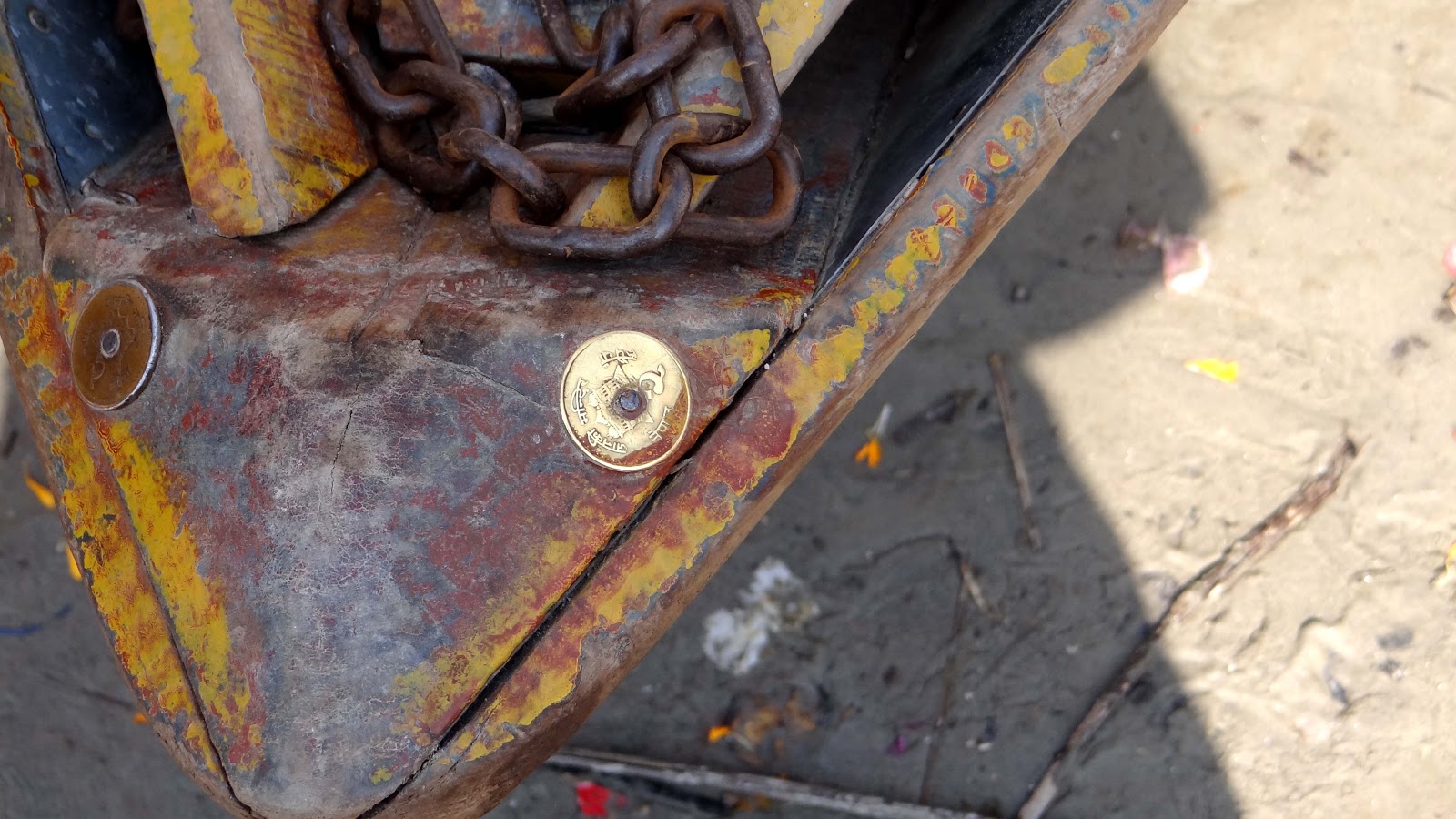
Innovative use of a coin. Rajeev was of course not too happy!
Ayodhya, named after King Ayudh, its founder and a
fore-father of Lord Rama is situated on the right bank of the Saryu (Ghagra
river). However, according to the “Ramayan” (ancient Hindu Text on the life and
times of Lord Rama) it was founded by Manu, (the ancient Law giver). It is one
of the 7 most sacred cities in India for the Hindus, Varanasi being the most
sacred. But other religions have also prospered here at different times. 5 Jain
Tirthankars were born at Ayodhya, including Adinath (first Tirthankar),
Ajitnath (second Tirthankar), Abhidanath (fourth Tirthankar), Sumatinath (fifth
Tirthankar) and Anantnath (fourteenth Tirthankar). According to the Jain Agams,
it is the second eternal city after Shikharji, which never vanishes or
disappears when eras change.
Ancient Jain Temple
During the Maurya and the Gupta period many Budhist temples
and monuments and centres of learning were established which we did not have
the time to explore. Faxian, a Chinese monk, recorded several Budhist monasteries
that he saw there.
The founder of the Swaminarayan sect lived here during his
childhood and started from here his seven year journey across India as ‘Neelkanth’.
Ayodhya’s influence and fame goes beyond our borders. As
recorded in an 11th century Korean chronicle King Suro of Geumgwan
Gaya wed a princess from Ayodhya in 48 CE. The local Ayodhya authorities and
South Korean government acknowledged the connection by having a joint function
to install a statue of the princess on the banks of the Saryu River. The Thai
kingdom and city of Ayutthaya, and the Indonesian sultanate of Yogyakarta, were
named after Ayodhya.
Saadat Ali Khan, the Nawab of Awadh, gave Ayodhya as a gift
to his loyal soldier, Dwijdeo Mishra, for quelling a revenue rebellion. In
1856, Ayodhya was annexed by the British and the sparks of the mutiny in the
subsequent year were mainly lit here.
Notwithstanding the “Ramjanmbhoomi” controversy, Ayodhya has
been an epitome of communal harmony and remains so till date. Everybody would
have heard of Munne Mian, the devoted caretaker of the famous Ramji temple, who
looked after it till his death in 2004.
Temples and places to see in Ayodhya
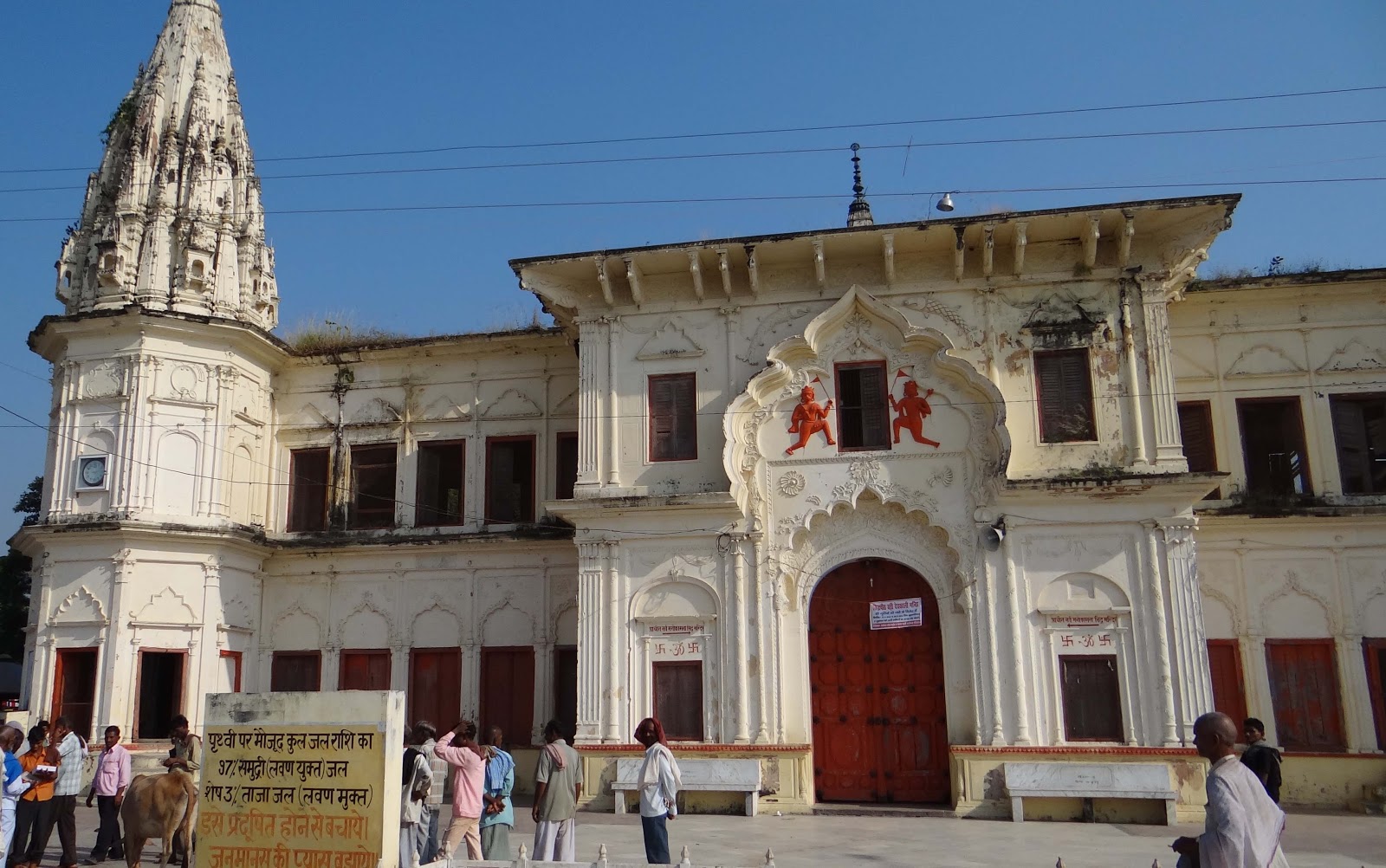
Hanuman Garhi :
The famous Hanumangarhi temple was built by the Nawab of
Avadh. (Legend has it that Hanuman lived here in a cave and guarded the “Janambhoomi”
or “Ramkot”. The temple is housed in a four sided fort with circular bastions).
The idol is of Bal Hanuman in the lap of his mother Maa Anjani.
Kanak Bhawan:
As per mythology this place was gifted to Sita by Kaikai
after marriage.
Ramkot:
The chief place of worship in Ayodhya is in the ancient
citadel of Ramkot and stands on an elevated ground.
Swarg Dwar:
Lord Rama was supposed to have been cremated here.
Mani Parbat and
Sugriv Parbat:
The first is identified with a stupa built by Emperor Ashoka
and the second is believed to be an ancient monastery.
Treta ke Thakur:
This temple is built where Rama is said to have performed
the Ashvamedh Yajna. Some 300 years ago the Raja of Kullu built a temple here
improved by Ahilyabai Holkar of Indore in 1784, and also built the adjoining
ghats. The idols in black sandstone were recovered from the Saryu and placed in
the temple, now famous as Kaleram-ka-Mandir.
Ornate temple door
Nageshwarnath
Temple:
This temple is said to have been erected by Kush, Rama’s
son. Kush, while bathing in the Saryu, lost an armlet which was recovered by a
Nag-Kanya who fell in love with him. As she was a devotee of Shiva, Kush built
this temple for her. It is said that this was the temple through which
Vikramaditya was able to locate Ayodhya as the rest of the city was in ruins
and covered by dense forests.
Nandi decided to pay Nageshwarnath a visit in person!
The legend (click to increase size of pic)
Beautiful old Ganesha idol
The resident devotees
We took a detour to Guptar
Ghat, where Rama was supposed to have disappeared from sight.
A painting on the outside wall of a temple.
parakeets nesting in the temple walls
After
having devoured all the varieties of ice cream being sold, to the delight of
this vendor, we drove through the spic and span cantonment in stark contrast to
the rest of the city of Faizabad to keep our date with Mishraji.
Dogra Temple
17th October 2012 Lucknow Zoo
After a break for a day, when we just walked around the lush
green compound of this complex we are staying in, and going around the local
market, yesterday we went for an outing to the Lucknow Zoo. Yeah! I know, cho
chweet and all, but wait till you see the pics.
The Lucknow Zoological gardens popularly called Banarsi Bagh
spreads over 71.6 acres and it has a pleasing layout with lots of greenery.
Since childhood I have been frequently going to the zoo but more for the
greenery than seeing caged animals. This time I saw some improvements and
changes. Oh yes the toy train is back on!
Check out this tiny video and put a smile on your face :-)
The beautiful Macaws
This one is there by choice! A water hen
A shy Lion Tailed Macaque which has a voice like a human's
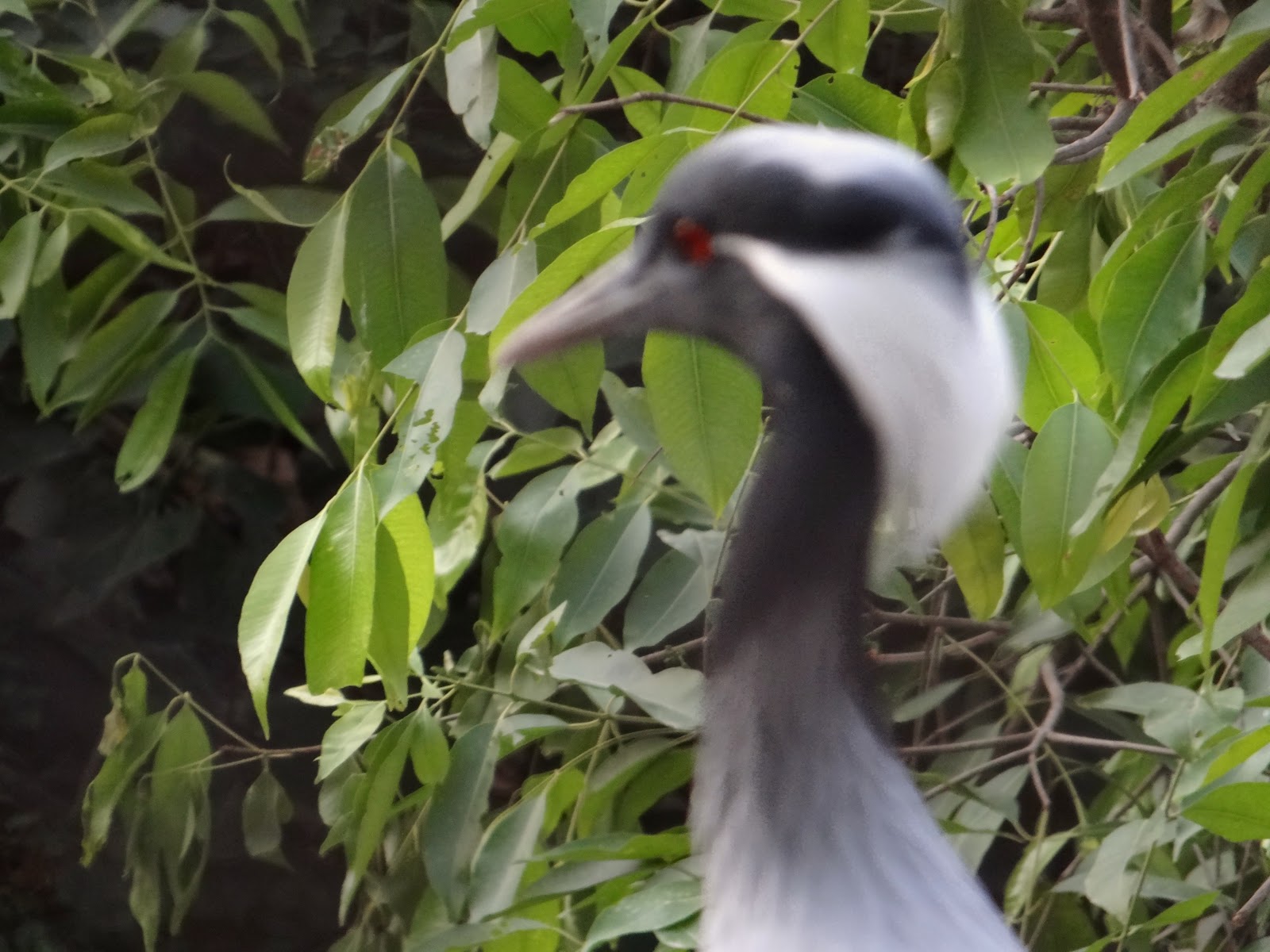
The Sarus Crane. State bird of U.P.
A pond heron. A free bird ofcourse!
Pelicans
A Painted Stork and its pretty pink feathers
Woolly Necked Stork
A Painted Stork. Balding!
A rose ringed parakeet
Zebra and friend
Frollicking dragon flies
A sad, sad Chimp called Smiley!. He sucks his thumb! poor orphan.
Sighting this Black Red Start in the zoo premises made my day!
Still pepped after 2 hours of zooing!!
Unreal!
His freedom is not impaired!
That's one hungry froggy.
You know you are in Lucknow when 'shers' (not tigers) are coming out of walls!
The zoo houses a small size museum too. Some of the artifacts displayed we liked quite a lot.
15th October 2012
Dewa Sharif
We travelled by the weekend train from Pune to Lucknow and
reached here the day before. This train is like a students’ special. All these
kids studying in the numerous schools and colleges of Pune, and the youngsters
working in the IT companies, are forever travelling back and forth in this
train. So we had the company of these two boys going home after their first
trimester in Law School. It was sweet to see these still green under the collar
youngsters returning home after leaving their homes for the first time. The
girls, Engineering students, and a little more senior, were much more confident
and a little irritated by the constant follow-up of their parents on phone. The
train was three hours late reaching, which made it 28 hours of travelling in
less than ideal conditions, but I am proud to say, I bore it rather stoically for
once.
Yesterday we felt good enough to drive some 30 kms out of
Lucknow to Dewa Sharif (dist. Barabanki) to visit the shrine of the Sufi saint Haji
Waris Ali Shah.
He died on 7th April, 1905 so the monument built in
his memory by both Hindus and Muslims jointly is relatively new and well
preserved. Built in the Hindu-Iranian style, it is quite appropriate to the
saint’s teachings and the inter-faith mix of his devotees. Haji Waris Ali Shah,
like Hazrat Moinuddin of Ajmer is of the Chisti order and he traces his lineage
to the Prophet.
While he lived, Haji Waris Ali was popular with people of all
walks of life and had even travelled to Europe. In fact one devotee, a Spanish
Nobleman, Count Galaraza came to visit and interview him all the way from Spain. His monotheistic teachings appealed to all.
If one enters the dargah with a still mind and devotion in the heart the surge of energy experienced is tremendous.
Jo Rab hai wohi Ram
Huge 'parathas' and 'halwa' selling outside
giant 'khajas'
The route is not without beauty. We had to stop the car quite a few times to appreciate pretty sights along the way.