KAUSANI
In a bid to escape the heat of the plains, my sister and I
made a trip to Almora and Kausani. We boarded the Bagh Express in the middle of
the night on 11th May which was technically 12th May
because the time was 0.05 hrs and reached at 9.30 the same morning. I had
earlier advised MK our friend in Almora that we were coming on the 13th
but ultimately reached a day earlier thanks to the midnight confusion. Thanks
to MK, we stayed in the most beautiful part of Almora, in the midst of
mountains, daisy covered paths leading up to picturesque cottages, surrounded
by pine trees. Little bit of heaven on earth! The neighbours and the owners of
the cottage made us feel so welcome that we were loth to go to Kausani the next
day. But we had pre-booked our stay in Kausani. Almora was very pleasant,
however, the taxi drive to Kausani seemed less than salubrious. The fields of
gold and green on both sides of the road failed to enthuse us because of the heat.
 |
| Paromita's picture of the golden fields of Kausani |
We landed at our relatively small hotel called Himvadi
Resorts – whose USP is a great view of the Himalayas and five small cabins with
glass windows which enable you to see the sunrise from your bed. However, in
the afternoon heat it didn’t feel all that inviting but we settled for it all
the same. It was a good decision because by evening there was a massive cloud
build-up and it rained through the night, bringing down the temperature so much
that the hotel had to provide extra quilts to all the guests. Out came our woolens,
carrying which had seemed like such a foolish idea when starting from Lucknow,
which was reeling under 42 degrees Centigrade.
 |
| colourful cabins named after the mountains |
 |
| From above |
THE SUNRISE
The next morning the sun rose from behind the Himalayas to
light up the sky and make the snow-clad peaks glow. The following peaks can be
seen from Kausani– Nandaghunti (21256mts), Trishul (25406mts), Nandadevi (25660mts),
Panchuli (22650mts), Nandakot (21644mts), Hathiparvat (22199mts), and on a
clear day Mana (23998mts). The majesty and beauty of the scene makes you want
to go down on your knees and worship these mountains. There were sounds of awe
mostly in Bengali and Gujarati all around us, while we clicked furiously to
keep up with the ever changing scene. Incidentally, on all the four days we
stayed in Kausani, apart from the Gujus and the Bongs there was always one
group from Pune in our hotel. (Swapnil, waiting to bump into you some day.) The
wander-lust of these two communities has really boosted the midrange travel
industry in India. Our taxi driver in Almora, however, rued the fact that they
bargained down prices so much. So here we were people from the east, west and
south of India mountain-gazing in the ‘’Switzerland of India’’.


 |
| View from inside our room |
THE WALKS
Kausani is famous for its sunrise and its ‘’walks’’. So after
the glorious morning show we decided to go for a walk along the lovely road in
front of our hotel unimaginatively called the Kausani-Bhatarya road. Don’t get
put off by the name, it is a most delightful experience. Wild daisies blooming
along the sides of the rambling, meandering road made a lovely sight. We walked
up about a km and a half with not a dull moment – catching sight of a bird
here, a butterfly flitting there, a wild flower blooming out of a wall or a
bunch of colourful dragonflies buzzing over a puddle of water. At one point I
caught sight of a jackal roaming on the road, but by the time my camera could
focus it had scooted for dear life and peered at me from behind a bush.
The roads in Kausani are by and large, easy going, the
gradient being even. We found a small provision store after a km and a half
where the road seems to turn into oblivion. On being asked, the owner, Sunder
Singh Bhandari, offered to make tea for us and took us upstairs to meet the
rest of his family. Sweet and trusting people of our hills – hope they never
lose their innocence. We got a bird’s eye view of the surrounding area from
their roof and could see the town of Baijnath where we proposed to go the next
day. Sundar Singh’s father, an
ex-seviceman, had fractured his foot which had not healed even after two and a
half months in plaster. I promised to bring him some homeopathy medicine which
fortunately I had carried with me (symphytum and calcarea phos for anybody
interested) the next day.
The senior Mr Bhandari rued the fact that there were not many
job opportunities in Kausani. The place is actually a village made famous by
two things – the view of the sun rising over the Himalayas and its son Sumitra
Nandan Pant, a famous hindi poet.
 |
| scenic walks in Kausani |
 |
| Kausani has innumerable wild flower varieties |
 |
| ''Ishalu" berries sold to me by a little boy. Best left for the birds. |
 |
| daisies sprouting just about anywhere |
 |
| wild roses |
 |
| Even the tree bark mesmerised me. |
 |
| No where to reach, no hurry |
 |
| Posing with some local ladies in their finery |
BAIJNATH
The next morning we went for a trip to this 12 th Century
temple by hiring a taxi from the taxi stand in the market square. The Baijnath
(Vaidnath – the lord of physicians) temple complex was built by the Katyuri Kings
at an elevation of 1126 mts on the left bank of the River Gomti. One of the
Temples dedicated to Shiva is called Bamani because it is said to have been built
by a Brahmin woman, overnight. The town is situated at the confluence of the
rivers Gomati and Garur where according to mythology Shiva and Parvati were
married.
We found the Temple complex surrounded by ugly modern day
residential houses which mar the beauty of this ancient structure.
 |
| The Baijnath temple complex from the top |
 |
| The main temple which has an exquisite Parvati statue. Most statues have been removed to prevent theft. |
 |
| steps leading to the temple |
 |
| This stone can supposedly be lifted by just the index fingers of 9 men - no more, no less and no other gender! |
 |
| Spring in Baijnath |
 |
| A pomegranate tree in full bloom |
The drive from Kausani to Baijnath through a pine tree lined
meandering road is rather pleasant. On the way back our taxi driver took us to
the Girias Tea Estate which unfortunately have shut down due to management
dispute. We bought the last few packets of green tea (Rs 1500 per kg) from the
outlets in front of the gardens. The chamomile tea we bought is also excellent.
 |
| Pine lined road to Baijnath |
 |
| Tea garden |
The last point the taxi took us to, was the Gandhi Ashram
also called Anasakti Ashram. Gandhi was besotted with the beauty of Kausani
when he visited it in 1929 and ironically wrote his treatise on “Anasakti” (detachment) ‘’yoga’’ here.
 |
| Gandhi Ashram |
That afternoon it again rained and everything became fresh
and cool. The mountain range could be seen sparkling in the sun and seemed as
if it was just a hop skip and a jump away. When it cleared we took a walk to
deliver the medicines to Shri Bhandari and on the way back got caught in
another spate of rain and hail. Took shelter at a baker’s who provided us
umbrellas to enable us to get back to our hotel.
 |
| Trishul |
 |
| Nanda Ghunti |
 |
| Up close |
 |
| Panchchuli |
We hung around another day walking up to the forest where,
our cleaning lady reported, the villagers went to collect wood and were often accosted
by the leopard. Unfortunately, we had no such luck! We saw a number of birdsthough.
 |
| Giving the leopard broad hints did not do the trick. |
After four days of just chilling out, seeing the snow clad
peaks change colours, and waiting and watching a silver oak just in front of
our cabin where some exotic bird or the other descended to keep me alert with
my camera in hand, we decided to return to Almora .
 |
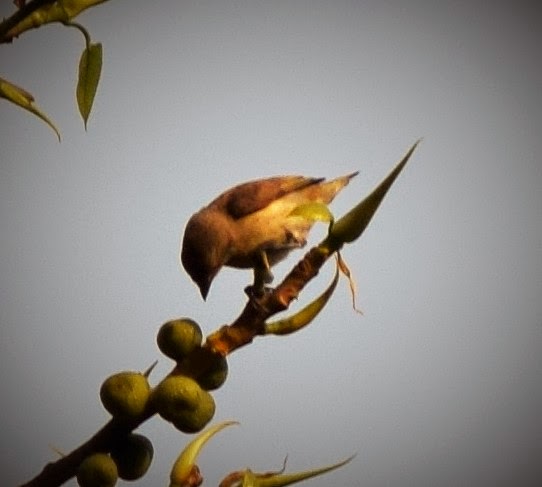
| The silver oak attracted a whole lot of birds. |
ALMORA
Puja and her mother welcomed us back like old friends and
their four dogs brought the roof down with their barking. Somehow, the dogs
could not decide whether to welcome us or treat us like outsiders. So they
barked and wagged their tails all at the same time.
 |
| Puja's whatsapp picture of her cuties | |
 |
| Kuku the doll |
 |
| My mobile picture of the view from the cottage |
We had another four days of
bliss, birdwatching or trekking up to the main road to Tara’s provision store. Tara’s
store caters to the foreigners staying in the cottages of Pappar Salli and sold
some great stuff. He baked a limited number of sesame brown bread which was to
die for. Thanks to him we would have breakfast of this wonderful bread, yak
cheese and rhododendron jam with garden fresh mint tea! For lunch and dinner we
would have Puja popping in with some exotic dish or another. She would be
scouting for a bunch of spinach in the market to make palak paneer for us. One day
she made a delectable chicken curry, whose recipe she cleverly (like a master
chef) didn’t share. If you are ever in Kumaon you must try the local ‘’bhat ki
dal’’, which Puja’s mother very graciously made for us.
 |
| Tara's shop |
 |
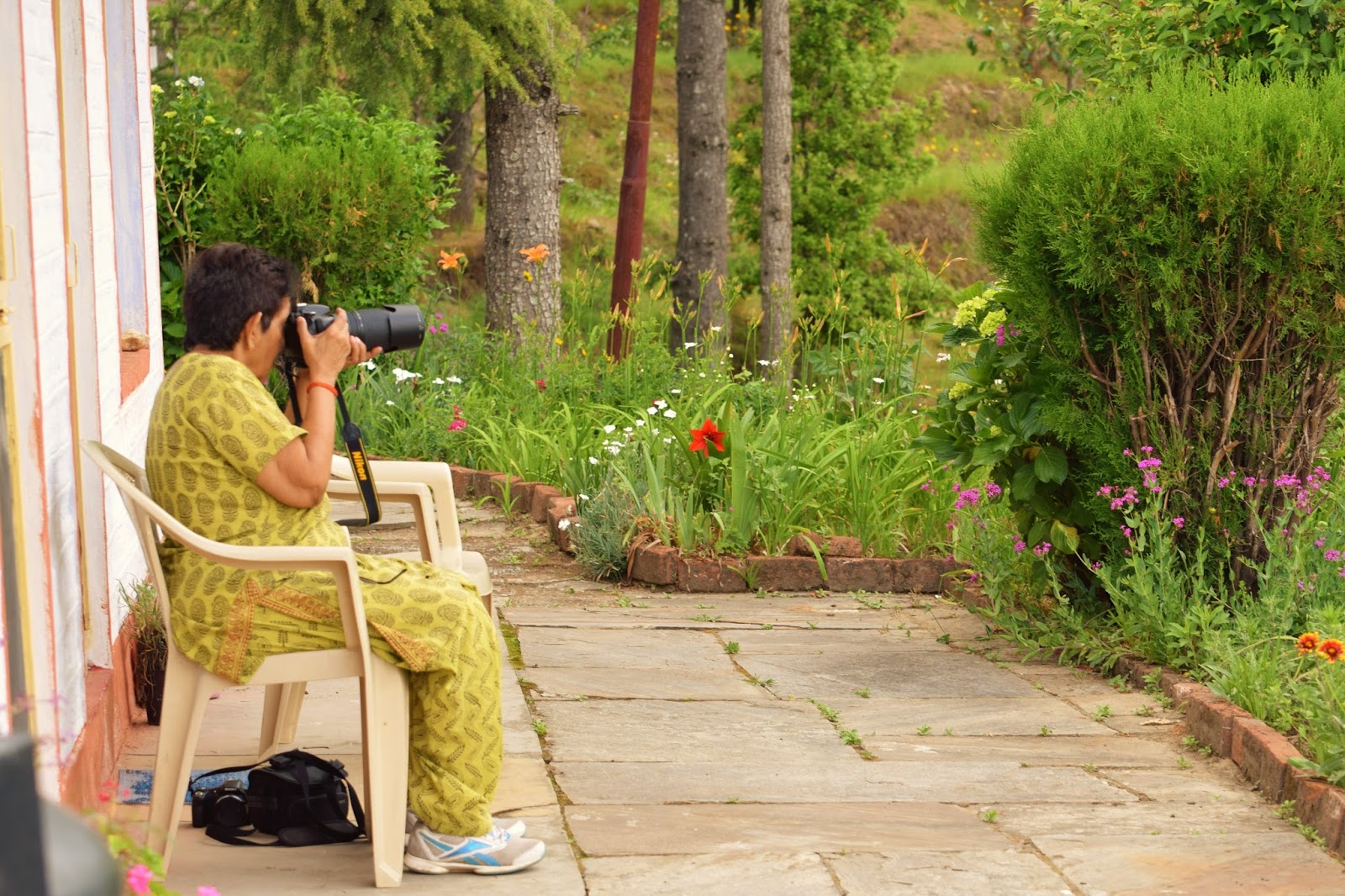
| Major part of our day was spent birdwatching from our cottage |
One day Puja accompanied us to the forest right at the top of
the mountain helping my sister (all of 70 years old) and the next day we went up
to the Eco park. It is amazing how easily we could trek on the mountain but
find it so difficult walking on plain roads here. Something in the air, I guess.
 |
| A house on top of the mountain surviving from pre-independence times |
 |
| Our cottage seen from the top of another mountain |
All in all, after a wonderful four days we took a taxi, with
heavy hearts, for Kathgodam railway station to board the Bagh express, back to
Lucknow. Incidentally, the new station is fantastic – clean and beautiful. One of
the best railway stations in India, I would say.
 |
| Love India. Keep her clean. |
**********************************************************************