Tiger Tiger
burning bright / In the forests of the night... (William Blake)
The lure of sighting the elusive orange predator of the
forest brought me to Lucknow in the hot, hot month of May (sans Rajeev), for a
visit to the Dudhwa Tiger Sanctuary, some 240 kms away. We (my sisters Paromita
and Raka – my usual partners in crime) hired a taxi, packed an overnight bag
and drove off in the wee hours of the morning via Sidhauli, Sitapur to Gola
Gokarnath, where we met up with Raka’s batchmate Dr Rajeev. After a brief break
at Dr Rajeev’s place (quickly digging into some soft spongy rasgullas) we
decided to leave our taxi and driver at Gola and pile into Dr Rajeev’s car
instead and travel together in one vehicle. The remaining 95 kms to the
Tigerrhino Resort were covered in no time, or so it seemed. We were well
stocked with food so decided to finish that first for lunch, though the guest
house has a good restaurant.
 |
| Tigerrhino Resort - named after the sanctuary animals |
The evening safari was scheduled to go at 4 pm so we decided
to take a small drive upto the visitor’s reception area. Enroute we stopped on
the bridge over the River Sharda and sighted a grey-headed fish eagle, drinking
water from the river.
 |
| Grey-headed Fish Eagle drinking water |
 |
| Just emerged from a coccoon |
 |
| A Blue Tiger ! |
I took it as a good omen and a promise of good sightings
to come. We came back to the Guest House from where the safari was to start.
The thrill of going on another safari on an open jeep made us oblivious to the
heat. It was cooler than the city in any case. So off we went in pursuit of
whatever the forest was willing to reveal to us. The teak and sal forests of
Dudhwa, interspersed with large stretches of grassland make it one of the most
scenic Tiger Reserves I have seen so far.
 |
| A Spotted deer blending in |
The customary spotted deer (chital) and langurs could be seen
but the forest was eerily quiet. Unlike us the animals and birds, unknown to
us, had decided to venture out only after sun-down. Suddenly the quiet was
disturbed and a bright green and red bird landed and upon closer examination we
saw it was the Emerald Dove. The bird has a penchant for dark shady places so
getting a picture from our perch atop the jeep was difficult.
 |
| Emerald Dove |
No visitor is
allowed to get off the jeep, except at special spots, in a Tiger Reserve, and
taking a picture of a small bird from a jeep is no mean feat. Though we saw the
red jungle fowl with hens and the flame-backed woodpecker, tantalizingly,
showed itself now and then, our guide wouldn’t slowdown in time for me to take
a picture. He, however, took us to some sighting posts near the swamps and
water-holes where we saw quite a few water birds and a herd of swamp deer
resting. Incidentally, the forest was initially declared a sanctuary for swamp
deer (1958) and much later (1987) declared a Tiger Reserve.
 |
| Adorable Rufous-headed Bee Eaters |
 |
| An Egret walking tall with a lapwing in the foreground |
 |
| A Red Jungle Fowl making a run for cover |
 |
| A Langur peering at us - he didnt have a camera unfortunately |
 |
| The swamp lined with water birds |
The evening safari
proved to be by and large uneventful though as the shadows lengthened with the
setting sun, the forest seemed more and more ominous making us whisper to each
other, nervously, even when a blade of grass stirred.
 |
| A Serpent Eagle perched atop a bare tree |
 |
| Greater Coucal |
 |
| Forest beauty |
 |
| Taking flight |
On the way back we again stopped on the bridge, and the
disappointment of not having many sighting was alleviated to some extent. We
heard our friend from the afternoon – the Grey-headed Fish Eagle, give out loud
calls (much like a peacock). Then we saw 3 Nilgais grazing on the banks merging
with the shadows of the dusk. Suddenly on the other side of the bridge we saw a
lone jackal pacing along the river and wading into the water to hunt. It formed
an amazing silhouette against the setting sun.
 |
| Nilgais |
 |
| Silhouette of a lone Jackal |
 |
| Cormorants drying their wings |
The electricity situation in the area is not good. The guest
house switched off the generator sometime in the night and we woke up in a
sweat at 2 am instead of 4 am to get ready for the morning safari. Opening the
windows and the front door brought in the cool breeze but also the mosquitoes.
All in all we would have done well to bring the mosquito repellant cream as
someone had suggested. On the flip side we were ready well in time for the
morning safari.
 |
| Elephant tracks |
 |
| Tiger pugmarks |
 |
| A Sloth Bear foot print - looking like a yeti footprint |
The morning safari was lively and the guide enthusiastic and
knowledgeable. Starting with a little Taylor bird sitting at arm’s distance
scolding its progeny, near the guest-house, we sighted a number of birds, and
animals, some usual, others not so much.
We saw the footprints of the big three animals you look
forward to seeing in Dudhwa – elephant, tiger and sloth bear – as a testimony
to their presence. The forest stretches over some 500 kms and therefore
sighting a big animal is surely a matter of luck.
 |
| Sunrise in the forest |
 |
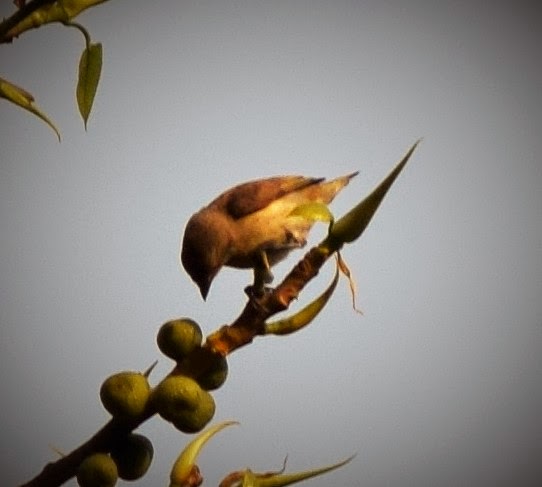
| A little Tailor Bird- harbinger of good things to come |
The ELEPHANT SAFARI
We first went for the Elephant Safari to see the rhinos. Our
elephant a coy, smiling female was called ‘’Pakhri”. She carried a Neem branch
in her trunk which she delicately swung around to keep the flies at bay. We
were lucky to see four rhinos grazing peaceably.
 |
| "Pakhri" our coy, smiling female elephant |
 |
| Rhinos grazing |
 |
| A railway line passing through the reserve which should definitely not be there |
Back on the jeeps we went on our quest of the great feline.
Suddenly we saw the black and white tail feathers of a large bird disappearing
in the forest. Sonu, our guide got quite excited and said we have sighted a
rarer creature than the tiger – it was the Great Hornbill! I felt a little
disappointed not getting a picture of it. A little ahead an Indian Pitta, a
very colourful bird caught our eye. It is rightly called “Navrang’’ in Hindi.
Inspite of being so colourful its camouflage was so good, with great
difficulty, only one of us managed a picture of it before it flew off. Some
Yellow-footed Green Pigeons caused some flutter, unfortunately they sat
directly overhead. At one point we saw quite a few Paradise Flycatchersfloating around.
Our guide took a lesser frequented path where someone had
reported hearing the tiger call and we were rewarded by – no not a tiger sighting
but the sight of the great big bird we had earlier missed – the Great Hornbill.
It sat there deliberately turning its huge beak first right then left then
going all the way down. We sat looking at its delightful antics and clicked to
our hearts content. My safari was a success!
 |
| Great Hornbill - the icing on the cake! |
After a breakfast of delicious stuffed parathas at the
guest-house, we retraced our steps to Gola Gokarnath to get back into our taxi.
Dr Rajeev took us to see the ancient Shiva Temple after which the town is named
while Mridula regaled us with the legend of Gokarnath.
**********************************************************************




.JPG)

.JPG)
.JPG)
.JPG)

.JPG)
.JPG)
.JPG)
.JPG)
.JPG)
.JPG)
.JPG)


.JPG)
.JPG)
.JPG)

.JPG)
.JPG)
.JPG)
.JPG)
.JPG)
.JPG)

.JPG)
.JPG)
.JPG)
.JPG)
.JPG)
.JPG)